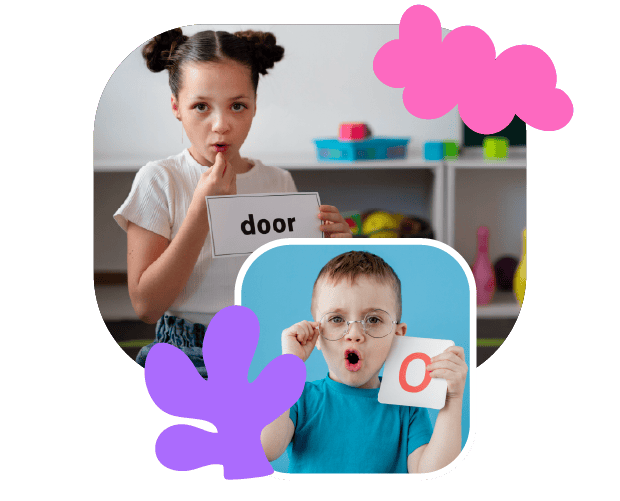
Speech sounds are the building blocks of spoken language. Children learn to produce these sounds using their tongue, lips, teeth, jaw, and voice. Over time, they combine sounds to form clear words and sentences.
It’s normal for young children to make speech sound errors when they’re learning to talk. But if those errors continue past the expected age, it may be a sign of a speech sound delay or speech sound disorder.
Speech sound difficulties can affect:
Articulation: how the sounds are physically made
Phonology: how the sounds are used and organised in words
Articulation refers to how a child moves their mouth, lips, and tongue to produce speech sounds correctly like “s,” “k,” or “r.”
A child with an articulation disorder (also known as a speech sound disorder) might:
Replace one sound with another (e.g. “tat” for “cat”)
Leave out sounds (e.g. “ca” for “cat”)
Say sounds in a slushy or unclear way (e.g. “thun” for “sun”)
These difficulties can make speech harder to understand, even when the child knows exactly what they want to say.
What Is Phonology?
Phonology is about how children understand and use sound patterns in words. All children go through predictable stages of phonological development, but some continue to use early patterns for longer than expected.
For example:
Saying “tea” instead of “key” is a common early pattern called fronting
Saying “nake” instead of “snake” is called cluster reduction
If these patterns don’t fade by the age expected, or are not considered ‘typical’ patterns, it may be a sign of a phonological delay.
When Do Speech Sounds Usually Develop?
Speech sounds develop gradually. Here’s a general guide to when children typically master each group of sounds:
By 3 years: /b, p, t, d, k, g, m, n, h, w, y/ By 3.5 years: /f/ By 4 years: /s, sh, l, ch/ By 4.5 years: /z, j/ By 5 years: /r/ By 7 years: /v/ By 8 years: /th/
If your child is still having difficulty with sounds that should already be established for their age, a speech sound assessment can help clarify whether support is needed.
What Are the Signs of a Speech Sound Difficulty?
Every child is different, but you might notice your child:
Is hard to understand, especially for unfamiliar listeners
Replaces sounds or leaves them out at the beginning, middle, or end of words
Speaks in a slushy, distorted, or unclear way
Uses early speech patterns that haven’t integrated (gone away)
Makes inconsistent sound errors across different words
Relies more on gestures or uses fewer spoken words
Hearing differences or limited early exposure to sounds
Co-occurring developmental or language differences
These challenges are not caused by laziness, poor behaviour, or lack of intelligence, and they are not your fault. With support, most children can make meaningful progress.
How Will Working on Speech Sounds Help My Child?
When speech is clear, it’s easier to understand, and everything else gets easier too. Talking, learning, playing, connecting- it all starts to fall into place.
With support, your child can:
Speak more clearly and confidently
Feel less frustrated when communicating
Be understood by teachers, peers, and family
Join in more easily during play and classroom activities
Form strong friendships and social connections
Build the foundations for spelling, reading, and writing
Speech Sounds and Articulation: Facts vs Myths
Myth: “They’re just being lazy.”
Fact: Speech sound difficulties aren’t about effort. Most children want to be understood so if speech feels hard, there’s usually an underlying reason.
Myth: “They’ll grow out of it eventually.”
Fact: Some children do improve over time, but others need support. If your child’s speech is still unclear, early intervention can prevent the gap from widening.
Myth: “Speech sound issues won’t affect learning- it’s just about talking.”
Fact: Children with speech sound difficulties are 4 to 5 times more likely to experience challenges with reading and writing. That’s why it’s important to support speech development early, monitor literacy progress closely, and offer support where needed.
Frequently Asked Questions
Is unclear speech caused by laziness?
No. Speech sound difficulties are never about laziness. They’re common and often need support to improve.
What’s the difference between articulation and phonology?
Articulation is how your child physically says the sounds. Phonology is how they understand and use sound patterns in words.
Does every child with unclear speech need therapy?
Not always. Some children catch up on their own. But if your child is hard to understand (especially by people outside the family), has speech sound errors that don’t fade by the age expected, or has ‘atypical’ patterns, it’s worth looking into.
Can unclear speech affect literacy?
Yes. Children with speech sound difficulties are 4-5 times more likely to have trouble with spelling and reading. Speech therapy can reduce that risk by strengthening foundational skills.
At Chatterbox we want the best for your family. Our therapists are kind and caring. They are passionate about working with children and helping your child to realise their true potential.